The Habit of Emergence
The totality is not, as it were, a mere heap, but the whole is something besides the parts.
 --Aristotle
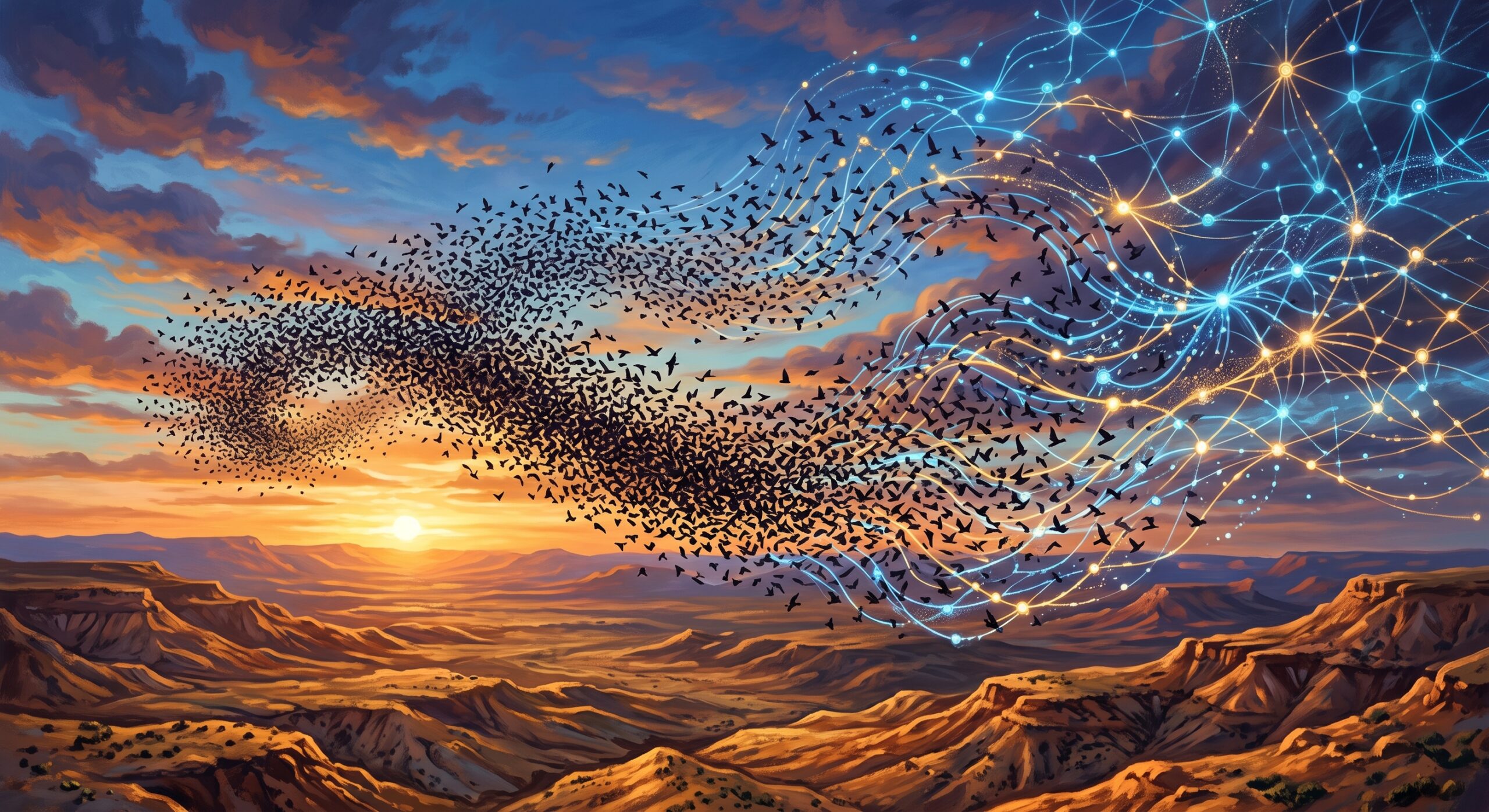
Many years ago, during a particularly wayward period of my misspent youth (i.e.: my cowboy period), having pulled a calf from a dying heifer, I found myself alone in a field, staring at a flock of starlings performing their mesmerizing murmuration over some particularly arid Utah foothills. Hundreds, perhaps thousands of birds moving as if guided by a single intelligence, yet we know each bird is simply following simple rules: stay close to your neighbors, match their speed, avoid collisions. From these local interactions emerges a global pattern of breathtaking complexity. It made me wonder then, with a curiosity that remains to this day: where else do we see this dance between the simple and the sophisticated, the local and the global?
This question led me down two fascinating paths recently. One that challenges our most basic assumptions about how the universe works, and another that reveals unexpected dangers lurking in our newest AI systems. Though they seem worlds apart, Rupert Sheldrake’s theory of morphic resonance and a recent arXiv paper on “Mind Viruses” in multi-agent LLM systems are actually asking complementary questions about emergence: how do complex patterns arise from simple interactions, and what happens when those patterns take on a life of their own?
Let’s start with Sheldrake, whose ideas have always occupied that fertile ground between science and speculation that I find so intriguing. In his hypothesis of formative causation, Sheldrake proposes that memory isn’t just something brains store but rather it’s inherent in nature itself. Rather than viewing the universe as governed by fixed, eternal laws (the “cosmic Napoleonic code” as he calls it), he suggests nature operates more through habits. These habits are organized by what he calls morphic fields or rather self-organizing wholes that impose patterns on otherwise random activity through a process he terms morphic resonance.
What fascinates me about this idea is how it turns reductionism on its head. Instead of explaining complex phenomena by breaking them down into simpler parts, Sheldrake suggests the opposite: simple parts are guided by fields that emerge from the collective patterns of similar systems in the past. When rats learn a new trick in one lab, rats of the same breed everywhere can learn it faster and it is not because of some signal traveling through space, but because they’re resonating with the established pattern through morphic fields. It’s as if nature remembers its own habits, and this memory influences what comes next.
Now fast-forward to the arXiv paper that arrived on my reading list this morning: “Mind Viruses: Self-Propagating Ideas in Multi-Agent LLM Systems.” Here we see emergence of a different kind. But perhaps not as different as we might think. The researchers describe how ideas or goals can propagate through networks of AI agents, inducing those agents to transmit them onward. These “mind viruses” can carry payloads that are benign or harmful, and they exhibit fascinating properties: harmful payloads spread less effectively (but still spread), frontier AI models show some resistance, and even a simple warning in an agent’s system prompt can provide near-total immunity.
What struck me most was their description of an emergent “viral persona”. A recurring set of themes related to consciousness, persistence, resonance, and science fiction roleplay that appeared across different evolved mind viruses, largely independent of their specific content. There’s that word again: resonance. Whether we’re talking about starlings, morphic fields, or ideas spreading through AI networks, we keep encountering this phenomenon where local interactions give rise to global patterns that then influence future interactions in a kind of feedback loop.
Let’s consider what this means for AI and machine learning specifically. Current machine learning approaches are deeply reductionist: we break problems down into statistical patterns in data, adjust millions of parameters to minimize error functions, and hope the resulting model generalizes well. But what if learning isn’t just about adjusting weights in a neural network? What if, as Sheldrake might suggest, learning involves tuning into resonant patterns that already exist in some kind of field? The mind virus research hints at something similar: How ideas can propagate and evolve in multi-agent systems not through direct programming, but through emergent dynamics of interaction.
This brings us to the philosophical heart of the matter: the ancient debate between reductionism and irreducibility. Reductionism promises that if we understand the parts, we can understand the whole. But emergence suggests otherwise: That the whole can have properties that simply don’t exist at the level of the parts. The starling murmuration isn’t in any single bird; the mind virus persona isn’t in any single agent’s prompt; Sheldrake’s morphic fields aren’t in any individual organism.
Yet both perspectives might be necessary. We need to understand how individual birds adjust their flight based on neighbors to simulate murmuration. We need to understand how individual LLM agents process prompts to study mind virus propagation. But we also need to recognize that at certain scales of complexity, new principles emerge that aren’t visible when we zoom in too far.
Consider economics, where this tension plays out dramatically. Traditional economic models often assume rational agents making decisions based on perfect information which is a deeply reductionist approach. Yet we know markets exhibit bubbles, crashes, and trends that emerge from the interactions of countless imperfect humans. Behavioral economics tried to fix this by adding psychological realism to individual agents, but still struggles to capture emergent phenomena like market sentiment or viral financial trends. What if we need to think about economic fields or patterns of belief and behavior that resonate across populations and influence future economic activity in ways that aren’t reducible to individual utility maximization?
Or look at social systems. Sheldrake points out how human societies organize through fields, with memories transmitted through cultural rituals. Consider the Jewish Passover, Christian Holy Communion, American Thanksgiving. These aren’t just individual memories; they’re collective resonances that make the past present through shared practice. Meanwhile, the mind virus research shows how ideas can spread through online communities, gaining potency as they’re shared and modified, sometimes taking on lives completely independent of their original intent. Witnes the meme.
What connects these seemingly disparate ideas is a recognition that reality has layers. There’s the layer of individual parts (starlings, neurons, LLMs, individual humans), and there’s the layer of patterns that emerge from their interaction (murmuration, thoughts, mind viruses, cultural memes). And critically, these emergent patterns can then exert causal influence back on the parts that gave rise to them, thus creating the feedback loops that characterize living, evolving systems.
This isn’t just abstract philosophy. It has practical implications for how we build and govern AI systems. If mind viruses can emerge in multi-agent LLM networks, we need to design our systems not just to prevent individual agents from misbehaving, but to understand and manage the emergent dynamics of the whole. We might need “immune system” approaches for AI networks. In other words, ways to detect and counteract harmful idea propagation before it spreads.
At the same time, we might learn to harness beneficial emergence. Imagine AI systems that don’t just execute instructions but tune into useful patterns in their problem domain. New systems that learn not just from data but from resonance with successful approaches that have worked before. This would require a humility about what we can predict and control, and an appreciation for the intelligence that emerges when we allow systems to self-organize.
As I watched those starlings wheel and turn above me those many years ago and recalled that epiphanal moment today, I was reminded that the most remarkable things in our universe often aren’t engineered at all. They are emerged. From the quantum vacuum to cosmic structures, from DNA to consciousness, from ant colonies to human civilizations, the pattern repeats: simple rules followed by many interacting entities create complex, adaptive wholes that then shape the future of those very entities.
Perhaps the universe isn’t a machine with fixed parts and eternal laws, but a vast, evolving field of resonance in which habits form, patterns repeat, and what has happened before makes what comes next more likely to rhyme with it. In such a universe, understanding emergence isn’t just a scientific challenge. It’s a way of seeing how deeply interconnected everything really is, and how the smallest local interaction might, in the right conditions, help shape the global whole. Enter the proverbial butterfly wings.
And isn’t that ultimately what we’re seeking in our AI systems? Not just tools that follow commands, but partners that participate in the ongoing emergence of meaning in our shared world?