A Day Without Data Centers
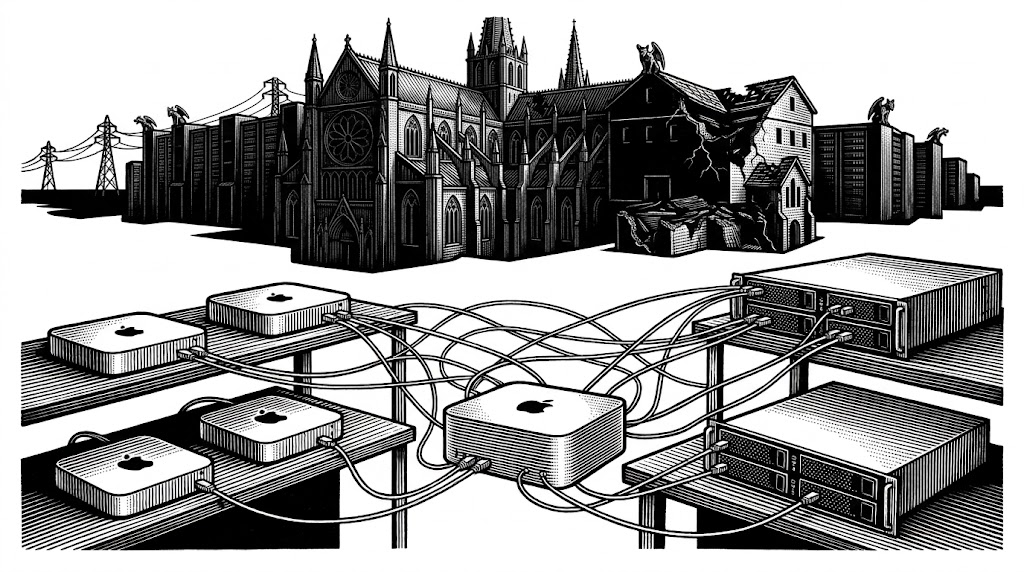
“One authoritarian, the other democratic, the first system-centered, immensely powerful, but inherently unstable, the second man-centered, relatively weak, but resourceful and durable.” — Lewis Mumford, Authoritarian and Democratic Technics, 1964
Lately I have been thinking about what my machines can do without my explicit permission.
A few weeks ago I fell into a rabbit hole about distributed inference. The old SETI@home idea had found its way into language models. Petals demonstrated collaborative inference on BLOOM, a model with 176 billion parameters, using consumer GPUs scattered across the Internet. Exo connects everyday devices into a local AI cluster, spreading work across the hardware already in the room. The latency math is brutal, and I will spare you another sermon on the speed of light.
What stayed with me was the wiring question. What, exactly, remains mine when the data centers go dark?
My own network makes the question literal. I have a small local fleet: a collection of Mac minis, one spare laptop and two Rocky Linux servers, each of those fitted with two respectable NVIDIA GPUs. A copy of GrokBot runs on my Mac Studio, where an agent I affectionately call GrokBoss manages the fleet for me. Ollama on each with qwen3.8:27b available across the whole arrangement. Between them, these machines can handle a litany of agentic AI tasks without asking a frontier model for help or sending the work past my router.
The names are playful. The topology is serious. GrokBoss can move a batch job to the machine with spare cycles, keep an interactive task close to the keyboard, and leave the cloud mostly out of the conversation. None of those machines is remarkable alone. The interesting thing is the arrangement. They know how to cooperate without first asking a distant landlord.
So let us run the experiment. No cyberattack. No solar storm. Those arrive with narratives attached. This is a cleaner thought experiment: tomorrow morning, every data center on earth stops working. Simultaneously. No warning, no graceful degradation. What happens?
To answer that, we first have to look at the massive, centralized structures we’ve surrendered our computing power to and the fierce public battles currently being waged over them.
Everybody Wants the Buildings
The buildings have become the most fought-over real estate in American politics, and everyone fighting agrees on one thing: They matter enormously.
Days before I began writing this, Dario Amodei published We Must Pace the Frontier. He asked frontier laboratories to slow the rate at which they improve model capabilities so that safety work has time to catch up. Within hours, Sam Altman said he agreed and Elon Musk answered, “Dario is right”. Three men who agree on remarkably little had found the same brake pedal.
Then politics swallowed it whole. The White House pushed back, competitors argued over who would hold the brake, and critics noticed that a speed limit written by the leaders could also become a wall against everyone behind them. The accelerationists love the models and they love the buildings more.
The protesters live next to them. A March 2026 Gallup survey found that 71 percent of Americans opposed an AI data center in their area, including 48 percent who strongly opposed one. In San Jose, KQED found residents organizing around higher electricity costs and strained water supplies before the next wave of projects received permits. Pollution joined the list. Willie Nelson objected to data centers “invading our land” near Abbott, Texas. In an open letter reported by USA Today, he wrote, “Whoever controls food and water, controls the masses.” I love Willie; perhaps a bit of hyperbole can be forgiven in this case.
Interestingly, the opposition has jumped the usual partisan rails. Conservative farmers and Sierra Club organizers have found themselves in the same rooms, objecting to shrinking farmland, pressured water supplies, higher electric bills, and the speed at which projects move through local government. Some of the anti-data-center and anti-AI politics is very ill guided. A warehouse full of servers has become a convenient idol on which to hang every fear about automation. Yet the water and power are real. So is the land and the constituency gathering around it.
New York went further. In July, the governor announced a one-year statewide pause on new hyperscale data centers while the state writes rules for energy and water use plus the effects on communities. Morgan Stanley separately estimated $156 billion in projects were canceled or delayed during 2025, while forecasting just under a trillion dollars in AI capital spending during 2026. Those are different numbers. One measures resistance already encountered. The other measures the force still headed toward it.
Three factions now circle the same substations. The accelerationists want more capacity, faster. The neighbors want a veto over what arrives beside them. The safety advocates want somebody accountable for what happens inside. Everything runs through the buildings.
They disagree about nearly everything except the concentration. From the street, the building carries too much cost. From the frontier lab, the machines inside are advancing too quickly. From Washington, control of the buildings has become national strategy. Distributed intelligence begins to look less like a hobbyist’s alternative and more like the architecture left standing when no faction can get everything it wants.
That makes the thought experiment less fanciful than it first appears. Tomorrow morning, all of it goes dark.
When the Cathedral Goes Dark
Reality has already nicked the edge of the thought experiment. In March, Iranian strikes directly hit two AWS data centers in the United Arab Emirates and damaged another facility in Bahrain. Six months later, AWS acknowledged that some of the destruction exceeded what its regional and multi-availability-zone systems were designed to withstand. Resources and customer data stored only in the destroyed locations could not be restored. The company is replacing affected infrastructure, but the missing bits are not coming back.
This was no software outage and no metaphor. Concrete broke. Power failed. Water from fire suppression damaged what the strikes had spared. Customers who had treated “the cloud” as a place beyond geography discovered that it had an address after all.
Start with the scale. Data centers consumed about 415 terawatt-hours of electricity in 2024, according to the International Energy Agency. That was 1.5 percent of the world’s electricity. The agency now expects data-center electricity consumption to double by 2030, while consumption by AI-focused facilities triples.
That is the construction story. The installed base still carries decades of less glamorous work: databases and payment systems. It also carries medical records, airline reservations and payroll. Then there are the systems for inventory and identity, plus the countless small services that keep one institution talking to another.
The first casualty is not the AI revolution. It is the boring machinery of modern life.
In the first minutes, the remote APIs stop answering. ChatGPT, Claude, Gemini, every agent framework, every AI button tucked into a subscription product. Dark. Anyone whose workflow had quietly become “ask the model, then verify” discovers how much of the verifying they had stopped doing. I wrote about this narrowing in Thinking in AI. Unused capacities do what unused capacities do.
Then the dependencies begin to announce themselves. A warehouse still contains its boxes, but its remote inventory system has forgotten how to name them. A hospital still has doctors and medicine, but the electronic chart is elsewhere. A truck still carries food, yet the scheduling system that placed it on that road has vanished. Some local control loops keep running. Others wait for an answer that will never arrive.
The stranger failures happen on machines that appear perfectly healthy. The application is installed. The file is on the disk. The processor is idle and the screen is bright. Yet the license server cannot be reached, the identity provider cannot vouch for you, or a feature flag in another state never arrives. The machine has the capacity to do the work and none of the authority. We sold that authority separately, then forgot it was part of the product.
By evening, the failure has changed texture. Software failure becomes coordination failure. The treatment plant can operate its machinery, but its chemical supplier has lost the order. The generator starts, but the market that scheduled tomorrow’s fuel does not. The card in your wallet remains a piece of plastic. The institutions that settle the promise printed on it have gone silent.
This sequence is a counterfactual, not a forecast with timestamps. Real systems carry backups and paper procedures. They have private networks. They also have generators and people who improvise. The order would vary. The architectural lesson would not. Systems with local state and local authority would fail differently from systems that delegated both to a distant building.
What survives would tell us what we actually owned: the files on a local disk, the software that never needed to phone home, the model weights already sitting on a machine in the rack. Ownership becomes visible when permission disappears.
Ephemeralization, Inverted
Buckminster Fuller gave us the language of “doing more with less”. He called the tendency ephemeralization. Computing has followed that physics for sixty years. Components shrank. Capability spread. The machine that filled a room became the device in a pocket.
The hyperscale data center runs the film backward. We took software, the most copyable artifact human beings have made, and concentrated it into concrete, copper, and cooling water. A typical AI-focused data center can consume as much electricity as 100,000 households. The largest facilities under construction may consume twenty times as much. We miniaturized the transistor and centralized everything around it.
The cloud won its place honestly. Renting the next machine was cheaper than buying it. A small team could reach the world without first building a machine room. Engineers traded capital expense for a credit card and gained astonishing speed. Each decision made sense on its own. The accumulation changed the bargain. The rented machine became the rented database, then the rented login, then the rented intelligence that explains how the rest works.
Ephemeralization reduced the material required for a unit of capability. Centralization increased the material placed behind a single decision point. Those forces can coexist for years because the bill arrives in different envelopes. One appears as cheaper computation. The other appears as systemic dependence, which carries no line item until the morning it does.
Mumford saw the pattern sixty years ago. His authoritarian technic was system-centered and immense. Its democratic counterpart was smaller, directed by the people using it, and difficult to erase in one stroke. The instability comes from the topology. Concentrate the compute and you concentrate the failure. Every efficiency of scale widens the possible blast radius.
The Shadow in the Substation
And now for the shadow.
The concentration is technical, economic, and jurisdictional. A small number of companies operating under a small number of legal regimes provide the substrate beneath commerce and government. Hospitals use it too. In What Will Endure in Agentic AI, I returned to the Eight Fallacies of Distributed Computing from my own book. One of them says there is one administrator. The cloud turned that old mistake into a region-selection menu.
A region is still a place. It has a grid, a water table, a permitting authority, and neighbors who vote. It sits inside a country that can tighten an export control, change a tax rule, or decide that inference has become a strategic asset. The President’s anger over an American company considering a Finnish data center exposes the truth. Even the accelerationists understand that the buildings are political objects.
The economic shadow is darker. A funding winter leaves computers in laboratories and ideas in unfashionable corners. A capacity winter leaves substations, cooling systems, and debt. Conviction does not pay the power bill.
The shadow also falls on us. Convenience becomes dependence one unexamined choice at a time. First we move the file. Then the application. Then the identity system that grants access to both. Eventually the local machine is a glass rectangle asking a distant administrator whether its owner may proceed.
What the Dark Reveals
A thought experiment earns its keep only when it changes what we build on Monday.
The dark reveals that resilience will come from Mumford’s democratic technic. A machine in your rack with weights it can load without asking permission. A private cluster assembled from hardware you already own. A public swarm such as Petals when the work can tolerate strangers seeing fragments of it. Each node is modest. The topology makes the whole harder to silence.
Orchestrated Tiers
The interesting architecture is orchestrated tiers. Keep the interactive loop local, where latency is physics you control. Send batchable work to machines you trust when time costs less than central capacity. Use a public swarm only for material you would say aloud. Cloud, cluster, rack, laptop. The workload should fall as far toward the user as its size, sensitivity, and urgency permit.
The case for distributed intelligence no longer depends on one theatrical apocalypse. A missile can remove a region. A town council can refuse the next building. A frontier laboratory can choose, or be forced, to slow the rate at which centralized capability advances. None of these outcomes ends computation. Together they make intelligence confined to one class of distant building a political and physical gamble.
A distributed intelligence layer may become the only viable way to keep ordinary agentic work available across all three. The practical design puts a useful floor of intelligence close to the people doing the work, then treats frontier access as an accelerator instead of oxygen. My fleet is inelegant and small, assembled from machines bought for other reasons. It can still do useful work when the frontier is unavailable, unaffordable, or politically out of reach.
The dark reveals something less flattering too. The people who fare best are the ones who kept a local copy, who know what sits underneath the API, and who can still perform the task the model performed for them. Slower, perhaps. Worse, probably. Still able.
Here’s the bottom line: Every dependency you cannot survive is a dependency you should be pricing.
The Missing Prime Directive
Do not ask whether the data centers will come back. Their return sits outside your control. Ask what you built that assumes they must.
Bet on the patterns rather than the implementations. Providers will merge. Regions will rebrand. The buildout will either earn its cost or become an industrial ruin measured in gigawatts. The politicians will keep fighting over the buildings because a permit is easier to debate than an architecture and it makes for good theatre.
The plumbing that survives will be the plumbing that never needed permission: local weights, open protocols, and mesh topologies. Fuller’s ephemeralization remains the physics. We took a long detour through the cathedral and maybe we needed to in order to land here.
Meet me on the corner of State and Non-Ergodic. Bring your own GPU.
Network Distributed Intelligence
Just so you know I’m writing a book about this, hoping to publish before the end of the calendar year. I’m calling it Network Distributed Intelligence and promise to include the word
fitscapes in the title because it is still apt. The architecture described above will be detailed in that text. I’ll post the availability of it here when it’s done