The No-Regret Portfolio
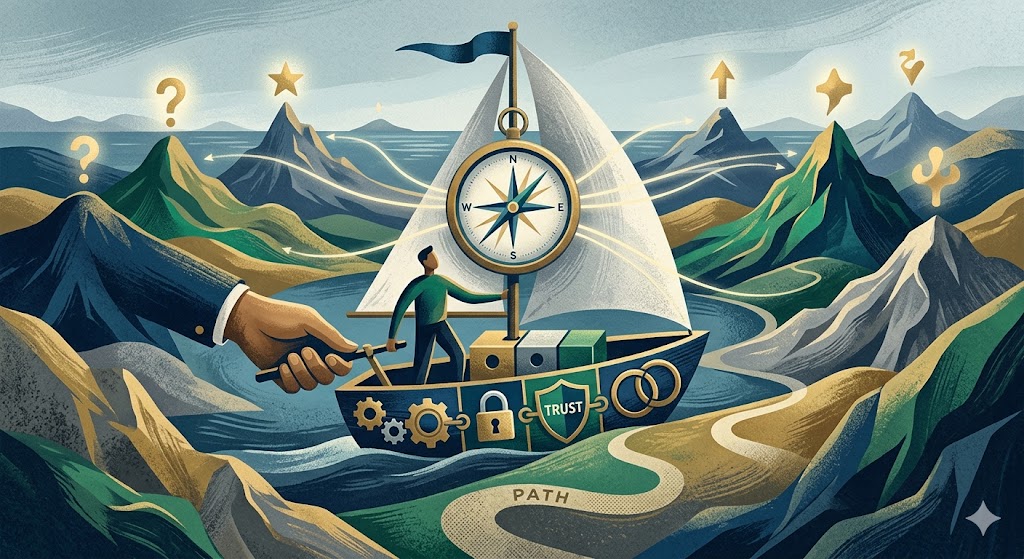
You cannot win a bet on a future impossible to predict.
You can only become a human who survives regardless of outcome.
Three AI fears walk into a bar. The first tries to order everything on the menu at once — the FOMO – the fear of missing out, certain that everyone else has already learned the incantations, automated their mornings, and pulled ahead while it was still reading the release notes. The second won’t order at all, convinced the bar is about to automate away its job, its paycheck, and the slice of identity that came bundled with them — the FOBO – the fear of becoming obsolete. The third sits alone in the corner, swearing the whole place is going to burn down with everyone inside — the DOOMER – the fear of dystopia, of an intelligence that does not stop at taking our work but goes on to take everything, up to and including us. One says run toward it. One says hide from it. One says it is already too late.
Behind the bar stands the strangest bartender any of them has ever seen — a quantum computer navigating infinite dimensions, fluent in every branch of the many-worlds multiverse. Call it the perfect forecaster, the oracle each fear secretly wishes existed, and, not incidentally, the very intelligence all three of them walked in afraid of. It has already poured every drink on every possible night this bar will ever have. So the three fears do what frightened people always do in front of an oracle: they shout their questions over one another. Which future wins? Will I still be here? Do we make it? And the bartender — who can see every world at once — cannot quiet a single one of them.
Then I walk in, pull up a stool, and order, “Whatever’s good in every world.” And the bartender, for the first time all night, smiles — because that is the only order in the house it can actually fill.
That last order is the whole argument of this post, so let me pour it out slowly. All three fears are forecasts. Each is a bet on one particular future — one where adoption is everything, one where displacement is everything, one where extinction is everything. And every one of those wagers is unwinnable, because the future it bets on is not a thing anyone can know. The cure is not a better prediction. It is to stop predicting and start preparing — for many futures at once. Two of these fears, the running one and the hiding one, you can largely answer by yourself. The third you cannot, and before we are done I will argue that this is the most important fact in the essay.
Against Prophecy
I am a recovering forecaster. I spent years evangelizing, predicting, consulting — building decks that promised to see around corners, writing blogs that assured technical solutions, and shouting to all that would hear the bright technology-enhanced days ahead if only we’d deign to see it.
Thirteen years ago I came back to hands-on software engineering partly because the corners kept moving. So let me say plainly what the prophecy industry will not: nobody selling you a confident AGI timeline knows what they are talking about.
Alas, I’m no Seldon. Asimov gave Hari Seldon a psychohistory that could forecast the arc of a galactic civilization — but it worked only on populations, never on individuals, and even Seldon’s mathematics had a hole in it shaped like the Mule, the wildcard nobody modeled. The honest version of AI forecasting is the same: maybe a shape at the level of the whole, and a Mule waiting in the particulars. Anyone selling you certainty — utopian or apocalyptic, the singularity or the extinction — is selling psychohistory without the math.
So if we cannot predict, what do we do? We change the question. The right question is not which future is coming but what should I do that pays off across most of them. Decision theorists call these no-regret moves — actions that leave you better off, or at least no worse, whichever way the world breaks. They are the closest thing to a free lunch that an uncertain world allows.
There is a deeper reason this matters, and it is the most important idea in this entire essay. The world is Non-Ergodic. In an ergodic system, the average over time equals the average over outcomes: run the experiment a thousand times and the typical result is the expected one, so you can safely optimize for expected value. Your life is not that system. You get one path. If a bet ruins you, you do not get to average it away against all the parallel futures where it paid off — those futures are gone, because you are out of the game. This is why expected value is the wrong compass for a single human life and why survival is the right one. You do not optimize the average future. You optimize the path you are actually walking.
I think of it as another Fitscape — the fitness landscape of possible futures, ridge after ridge of them. A prediction is a bet that you have found the one true peak and can sprint to it before anyone else. A no-regret move is different: it raises your elevation across the whole terrain, so that wherever the ground turns out to be solid, you are already standing higher. What follows is a portfolio of exactly those moves. Not prophecy. Robustness.
The No-Regret Portfolio
Start with fluency, but be precise about which kind. Spend regular time — thirty to sixty minutes a day, or weekly at the very least — using a frontier model on the actual work of your actual life. Draft with it. Analyze with it. Learn from it, plan with it, argue with it. The goal is emphatically not prompt engineering, a skill that may evaporate the moment the next interface lands. The goal is calibrated judgment: a gut-level, earned sense of what these systems genuinely do well, how they fail, and — the part nobody practices — when not to reach for them at all. Treat the model as a brilliant, tireless, occasionally delusional junior assistant whose work you always check. Never as an oracle. The fluency that lasts is not knowing the spells; it is knowing the limits.
From fluency, migrate. AI comes for tasks long before it comes for jobs, and the people who get blindsided are the ones who think in job titles instead of task lists. So audit your own work honestly. Which of your tasks are repetitive, pattern-based, and text-heavy? Assume AI assistance there becomes not optional but mandatory — and soon. Which of your tasks require accountability, trust, physical presence, negotiation, or judgment that crosses domains? Invest disproportionately there. The most durable position in the whole landscape is not the technologist who only knows the tools; it is deep domain expertise fused with AI fluency — the nurse, the lawyer, the electrician, the analyst who wields these systems well inside a field they already own.
But hold that tilt loosely, because it collides with what I’ll call the Agency Uncertainty Principle: the more confidently you declare a domain safe, the less you can trust the declaration, because the act of automating it is already underway somewhere you cannot see. Today’s safe harbor is tomorrow’s automated channel. This is precisely why optionality — the capacity to move — matters more than any single brilliant pivot. Do not bet the farm on one prediction about which skill is sacred. Bet on your ability to learn the next one.
Then build slack — financial and temporal both. If AI raises anything, it raises the probability of discontinuous income shocks: not a gentle decline you can plan around, but a cliff that arrives on a Tuesday. Non-Ergodic again — the shock you cannot average away is the one that ends the path. So reduce high-interest debt. Build an emergency buffer of three to six months, minimum. Keep your fixed obligations low enough that a bad quarter is survivable. Keep your portfolio current, your network warm, and where you can, develop a second income path before you need one. And be exactly as skeptical of the upside hype as of the downside dread: anything promising guaranteed returns, manufactured urgency, or a celebrity’s blessing should be treated as fraud until it proves otherwise. The same uncertainty that threatens your income is the soil where the grifters grow.
Harden the Walls
Of everything in this portfolio, this is the most immediate, the most concrete, and — wonderfully — the cheapest. Synthetic voice, synthetic video, synthetic text have made impersonation and persuasion scalable for the first time in human history. The old grandparent scam used to need a passable actor on a crackling line. Now it can call you in your daughter’s actual voice, mid-sob, asking for money before you finish your coffee. The threat is not science fiction. It is this quarter.
So build the walls now, while they are cheap. Establish verification protocols inside your family and your workplace: a code word for any urgent request, out-of-band confirmation before a single dollar moves, and an iron rule that voice and video alone are never proof of anything. Use a password manager. Turn on multi-factor authentication for every account that matters. Freeze your credit where you can. And before you believe — or worse, forward — any consequential claim, run it through four questions: What is the source? Is it corroborated? Who benefits if I believe it? And is this thing engineered to make me afraid or to make me rush? That last question is the tell, because fear and urgency are the master keys to human judgment. Notice that the three fears we opened with are the same keys, turned against you — the grift runs on FOMO, on dread of redundancy, and on apocalyptic panic in exactly equal measure. One last wall: do not pour sensitive perr
sonal, medical, financial, or confidential workplace data into AI tools your organization has not vetted. What you type into the wrong box does not come back.
The One Asset That Does Not Compress
Here is the move conventional advice underrates most and the one this thinking emphasized most — which tells you something about conventional advice. Invest in human relationships. High-trust networks — professional, familial, civic — are the one asset no technology substitutes for, and they pay dividends in every single scenario, including, especially, the bad ones. A dense local network gives you information you can triangulate against the synthetic flood, mutual aid when the cliff arrives, and meaning when the work changes shape. You cannot download it, cannot clone it, cannot prompt it into being. You can only tend it, slowly, over years.
Pair that with two quieter disciplines. Keep your analog competencies alive — the capacity to think, navigate, calculate, and decide without a screen mediating every step — because a self that only functions through digital prosthetics is a self with a single point of failure. And keep some activities you value for the doing rather than the output: the garden, the instrument, the long walk, the workshop. These are not hobbies. They are insurance against a particular kind of poverty — the displacement not of your income but of your purpose. A machine can take your task. It cannot take the satisfaction you did not outsource to it.
The Lifeboat Fallacy
There is a shadow side here, and my regular readers know I cannot look away from the shadow. The shadow is not hiding inside any single item on that list. It is in the framing of the whole list — including, I confess, the framing of this essay. Every move I have offered is private. Each one quietly assumes that preparation is a personal duty, that the responsible individual can study and save and verify their way to safety. And at the scale of one reader, that is true and worth doing. At the scale of a society, it is a fallacy.
I have spent a career naming fallacies — the Eight Fallacies of Distributed Computing chief among them — so let me name this one. Call it the Lifeboat Fallacy. If AI displaces labor at scale, then telling everyone to reskill into the shrinking pool of “AI-proof” work is mathematically incoherent, because the lifeboat has fewer seats than there are passengers. You can train every individual to swim harder; you cannot, by training, add seats that do not exist. No amount of personal grit resolves an arithmetic problem.
Which means the genuinely important preparations are partly collective, and they live where individual advice cannot reach: social safety nets robust enough for discontinuous shocks, some honest distribution of the productivity gains these systems generate, and transparency and accountability for the systems themselves. This is where our third drinker — the one in the corner certain the bar will burn — finally gets its due. The dread of a runaway, humanity-ending system is the single fear on our list that no emergency fund and no second income path can touch, because it is not a private risk and has no private hedge. Dismissing it as hysteria is exactly as lazy as surrendering to it. The honest response to a tail risk you cannot insure alone is neither panic nor denial; it is to help build the institutions that can carry it — to fund the safety research, demand the oversight, and refuse to let the systems that could end the game be governed by no onee
at all. So preparing wisely includes preparing as a citizen, not only as a worker. Pay attention to AI governance. Demand disclosure when an algorithm makes a decision about your hiring, your benefits, your child’s grade. Push your schools toward judgment, metacognition, and verification — toward the skills a model cannot hand in for you — and away from the memorizable output a model produces for free. And resist, hard, the narrative that those who fail to adapt were simply negligent. That story is flattering to whoever is currently winning and cruel to everyone else, and it is mostly false. The river does not blame the stones it leaves dry.
Neither Worship Nor Dread
Now we can return to our three drinkers and see them for what they are, because each fear, enthroned, becomes its own failure mode. The first enthroned becomes worship: chasing every model release, collecting expensive certifications like indulgences, mistaking motion for progress, betting everything on a single dramatic pivot. The second enthroned becomes withdrawal: the denial that refuses to look at AI at all, the slow surrender of letting your own faculties atrophy because the machine will do it for you, and the loneliest failure of the set — trading human company for synthetic conversation. The third enthroned becomes doom: the fatalism that insists “the window has already closed” or that the ending is written and resistance is theater — a posture both unsupported and quietly demobilizing, because despair, dressed up as realism, is just one more way of refusing to prepare.
All three are the same mistake in different clothing: each is a forecast masquerading as a strategy, a single bet placed on a single imagined future. The balanced posture is none of them — not worship, not withdrawal, not doom. Prepare seriously. Adapt continuously. And keep human judgment — yours — at the center of the loop, never at its mercy. The antidote to all three fears is the same, and we have spent this whole essay describing it: a portfolio of no-regret moves that does not require you to know the future, only to survive it.
Let Us Reason Together
Principles are cheap; the discipline is in the doing. So here is the smallest plan that still counts as serious — not a forecast, but a first step you could take before the week is out.
This month:
- Try AI on three real tasks from your actual work, and save what genuinely worked.
- Turn on multi-factor authentication and start using a password manager.
- Set one household rule for verifying urgent requests — a code word, an out-of-band call.
- Audit your job’s tasks for automation exposure: which are pattern-based, which are judgment-based.
- Start, or increase, an emergency fund.
This year:
- Build demonstrable competence in one AI-augmented skill inside your own domain — not the tool for its own sake, the tool in service of what you already know.
- Join one high-trust group, professional or local, where people share what is actually working.
- Reduce one concrete financial vulnerability.
- Engage at least once in your workplace’s or community’s conversation about AI policy.
Then reassess every six months — and here is the whole thing compressed to a single line. The discipline that matters is not having the right plan. It is updating the one you have.
The Missing Prime Directive
So stop trying to win the future. You will not, because it is not a contest with a finish line; it is a landscape you are already walking. Build the fluency, migrate the value, bank the slack, raise the walls, and — above all — keep the people close, because they are the part of you that no model can reproduce and no shock can fully take. Do the private work, and then do the public work, because some of this you cannot solve alone and it is not weakness to say so. Iterate. Adapt. Endure. And the next time any of the three walks into the bar — the one that runs, the one that hides, the one that swears it is already too late — you will already know what to tell all of them: I am not betting on your future. I am preparing for every one of them.
Meet me on the corner of State and Non-Ergodic.