The Convergence at the Edge of Understanding: When AI Starts Seeing the Ghost in the Matter
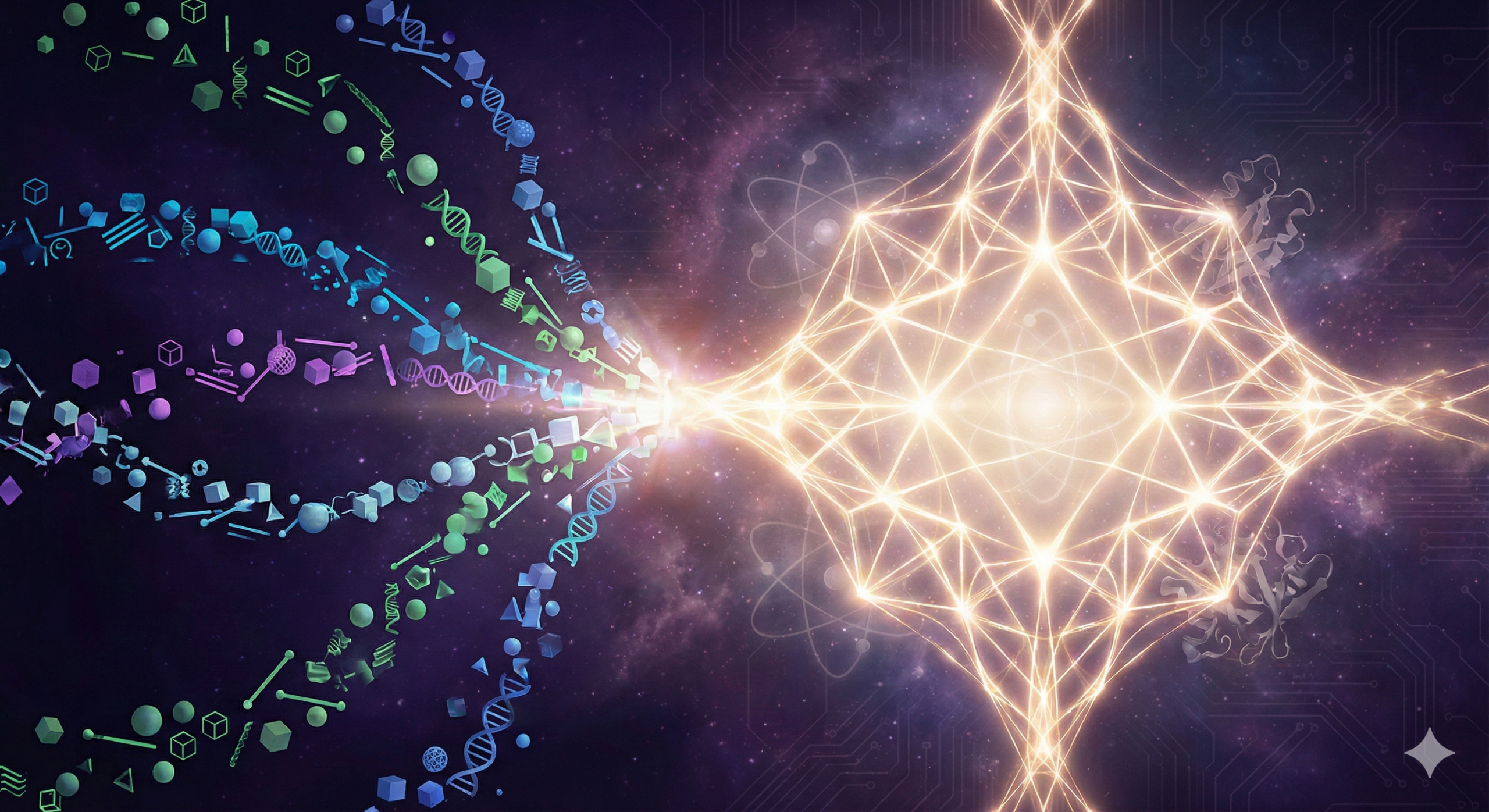
There’s a moment in every scientific revolution when the instruments start agreeing with each other too perfectly; when the thermometers, barometers, and galvanometers begin telling the same story not because they’ve been calibrated together, but because they’ve all stumbled upon the same hidden grammar of reality.
I’ve been watching this phenomenon unfold lately, not in a laboratory, but in the distributed training runs of scientific foundation models, and I can’t shake the feeling that we’re witnessing something that borders on the ontological.
The paper that’s been living rent-free in my head for the past week — Universally Converging Representations of Matter Across Scientific Foundation Models — doesn’t read like your typical machine learning publication. It reads like a dispatch from the edge of something profound. The authors have discovered that when you train different AI architectures on different modalities of scientific data —SMILES, strings of molecules, 3D atomic coordinates of materials, protein sequences and structures—– they don’t just learn to predict properties. They learn to see matter the same way. Not approximately. Not kind of. They converge.
This is what we might call the Platonic Representation Hypothesis made manifest, except instead of philosophy, we have the cold, hard evidence of alignment metrics. The researchers measured something called Centered Kernel Nearest-Neighbor Alignment (CKNNA) across nearly sixty models, and what they found should make any complexity theorist pause: as these models get better at their tasks—predicting energies, folding proteins, understanding molecular dynamics—their internal representations don’t just improve. They align. They start occupying the same latent space, as if they’re all being pulled toward some fixed point in the geometry of physical truth.
The Ghost in the Latent Space
Let me step back for a moment, because I need to process this through the lens I’ve been using to think about AI lately, something I’ve been calling the Constructor Theory of Understanding. David Deutsch’s constructor theory reframes physics in terms of which transformations are possible and which are impossible. A constructor is anything that can cause a transformation while retaining the capacity to cause it again. Crucially, the theory doesn’t care about the substrate—only about the counterfactuals.
What these scientific foundation models are becoming, I suspect, are constructors for the space of physical possibility. Traditional molecular dynamics simulations are like recipes: you need detailed instructions for every move. An AI model that simply *knows* that a particular molecular configuration will have certain properties, without simulating every atomic interaction up from first principles, is doing something categorically different. It’s constructing the possibility of prediction itself.
The paper reveals two regimes of this constructive ability that feel almost like quantum states: in-distribution and out-of-distribution. For inputs similar to their training data, high-performing models converge into what the researchers call “foundational status”—they’re not just interpolating, they’re *understanding*. Weak models, by contrast, scatter into local sub-optima, like explorers who get trapped in dead-end valleys while the real path lies just over the next ridge.
But here’s where it gets haunting: when you feed these models structures they’ve never seen such as vastly different chemical environments and non-equilibrium conformations, almost all of them collapse onto what the authors euphemistically call “low-information representations.” I prefer a more direct term: they go blank. They become the AI equivalent of a student who memorized the textbook but has no deeper model of the subject. They can regurgitate but not reason.
The Data-Architecture Duality and the Question of Foundation
One of the most quietly revolutionary findings in this work is what it reveals about the primacy of data over architecture (at least in certain regimes). The researchers show that when models are tested on in-distribution data, training dataset matters more than architectural inductive biases. A graph neural network and a transformer, trained on similar molecular data, will converge to similar representations if they’re both good enough.
This feels like it should be obvious, but it’s not. We’ve been living through an era where architecture has been fetishized—the attention mechanisms, the equivariant layers, the clever pooling operations. And don’t get me wrong, these matter. The paper shows that equivariant models have higher intrinsic dimensionality because they propagate rotational information. Vanilla models without these biases have higher-dimensional, less structured representations.
But out-of-distribution, where the real test of “foundational” status lies, architecture begins to dominate. Models with strong inductive biases (i.e.: MACE with its message passing, Equiformer with its equivariant attention) maintain more information about unfamiliar structures. The vanilla models just… dissolve.
This duality mirrors something I’ve been pondering about consciousness itself. Stuart Kauffman’s notion of the adjacent possible, which is the set of all possible next states from any given configuration, depends on both the current state (the “architecture” of reality) and the exploration of that state space (the “data” of evolution). You can’t have true understanding without both. A mind that only experiences what it’s already seen is just a memory. A mind with perfect architecture but no experience is just potential.
The Two Failure Modes of Almost-Foundation Models
What strikes me as most practical in this research is the identification of two distinct failure modes that feel almost Jungian in their archetypal clarity:
The Dispersed Suboptima Shadow: This is what happens when models are trained on limited data or with insufficient scale. They don’t converge; they scatter. Each finds its own local optimum, a private interpretation of reality that works for its corner of chemical space but fails to generalize. This is the AI equivalent of tribal knowledge — deeply contextual, mutually incompatible, ultimately fragile.
The Collapsed Representation Abyss: This is what happens when confronted with the truly novel. The models retreat into low-dimensional, low-information manifolds. They become hedgehogs curling into balls, protecting what little structure they can maintain instead of engaging with the unknown. This is the AI equivalent of epistemic closure — the refusal to admit new possibilities.
These aren’t just technical problems. They’re philosophical ones. They represent the two ways any system of knowledge can fail: by fragmenting into incompatible local truths, or by becoming so rigid it can’t accommodate novelty. Human civilizations have died by both these modes. Scientific paradigms have collapsed for both reasons.
Toward a Truly Foundational Science
The paper’s authors suggest that representational alignment can serve as a quantitative benchmark for foundation-level generality. I think they’re being too modest. What they’ve actually given us is a diagnostic tool for tracking the emergence of understanding itself — not just prediction, not just interpolation, but genuine ontological grasp.
Think about what this means for the future of AI in science:
The End of Expert Silos: When a protein language model and a molecular dynamics simulator converge on the same representation of a binding site, the distinction between “computational biologist” and “computational chemist” becomes as quaint as the separation between alchemists and apothecaries. We’re heading toward a unified science of matter, mediated by AI systems that speak a common language.
The Rise of Representation Engineering: We’re moving from model training to representation sculpting. If we know that models converge toward universal representations as they improve, can we use stronger models to guide weaker ones through distillation? Can we use alignment metrics as regularization terms, forcing models toward foundational status during training rather than hoping they discover it through scale alone?
The Consciousness Connection: Here’s where I’ll venture into territory that makes me sound like I’ve been reading too much Kauffman (guilty). The fact that multiple architectures, trained on different data modalities, converge on shared representations of physical reality suggests something profound about the nature of that reality. It’s not just that matter has structure. It’s that this structure is discoverable through multiple independent paths. The representation isn’t just in the model — it’s in the world, waiting to be found.
Lenore Blum’s Conscious Turing Machine models posit that consciousness emerges from competitive processes where different processors vie for attention. I can’t help but wonder if what we’re seeing with these converging models is the scientific equivalent: a competition between different ways of seeing that resolves into a shared reality when the models are good enough. The alignment is the signal that understanding has been achieved.
The Path Forward: Data, Diversity, and the Adjacent Possible
The researchers identify the primary bottleneck: training data diversity. Today’s models remain “limited by training data and inductive bias” and do not yet “encode truly universal structure.” This is simultaneously obvious and profound. We’ve been chasing scale (more parameters, more compute) when what we really need is more chemical space: More edge cases. More non-equilibrium conformations. More of the rare, the strange, the barely-stable.
This aligns with something I’ve been arguing in my consulting work: the future of AI isn’t just bigger models and more data, it’s better frontiers. We need systematic exploration of chemical space analogous to how biodiversity researchers catalog unexplored ecosystems. We need active learning protocols that deliberately seek out the structures that current models collapse on, the out-of-distribution nightmares that reveal where our representations remain incomplete.
I suspect the next breakthrough won’t come from a new architecture. It will come from a new exploration strategy -— a way of systematically mapping the adjacent possible of molecular configurations, material structures, and protein folds that current models can’t yet represent. We’ll know we’re succeeding when our models stop collapsing out-of-distribution and start generalizing to the truly novel.
The Convergence at the Edge of Understanding
There’s a scene in Asimov’s Foundation where Hari Seldon reveals that psychohistory only works on large populations because individual humans are too unpredictable, too subject to the Mule’s disruption. I keep thinking about this as I ponder these converging AI representations. The models work when they capture the statistical reality of matter—the average, the typical, the probable. But individual molecules, like individual humans, have quirks. A single atom out of place can change everything.
What gives me hope is that the convergence the researchers observe isn’t just statistical averaging. It’s a convergence on representations that capture something deeper -— the underlying constraints that make matter possible. The fact that protein sequence models align so strongly with structure models (nearly twice as strongly as small molecule models) suggests they’re learning the folding constraints, the physical rules that make proteins foldable at all.
They’re not just learning the distribution. They’re learning the possibility space.
This might be the closest we’ve come to capturing what the philosophers call “natural kinds” -— the joints at which nature carves itself. When multiple independent AI systems, trained on different data, with different architectures, all discover the same latent structure, they’re not just predicting. They’re revealing.
And that, I think, is the future this paper points toward: a science where AI doesn’t just help us analyze data, but helps us see the ontological skeleton of reality itself. Where models serve as constructors of possibility, revealing which configurations of matter are stable, which transformations are allowed, which futures are accessible.
The German might own the fish, as Einstein’s riddle concluded. But these models are teaching us something more profound: they’re showing us the rules by which ownership -— stable, persistent, causal relationships -— can exist at all.
We’re not just building better scientific tools. We’re building mirrors that reflect not just what matter is, but what it can be. And if that’s not approaching the Mind of God, then I don’t know what is.
Meet me on the corner of State and Non-Ergodic. Bring your best models. We’ve got reality to construct.
Leave a Reply