Agentifying Me
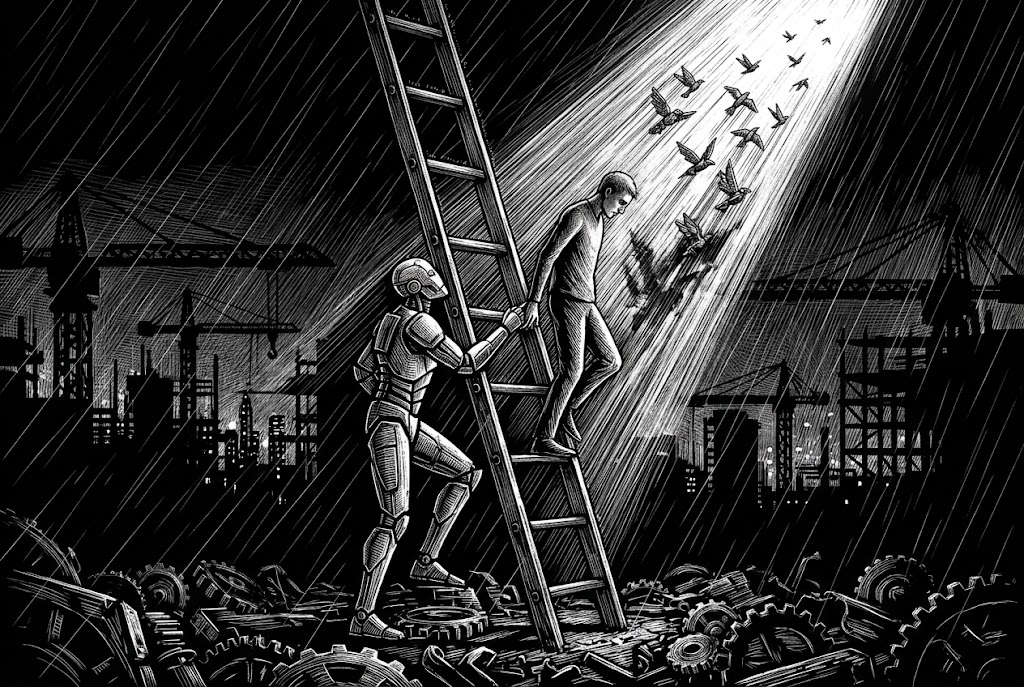
“Life imitates art. We shape our tools and thereafter they shape us.” — John Culkin, A Schoolman’s Guide to Marshall McLuhan, 1967. The line is nearly always given to McLuhan, and nearly always in a slightly different form than the one Culkin printed, which is its own small lesson about what survives contact with a system.
On the last Sunday evening in August a founder posted thirty features of an AI-native company. I read it the next morning, once with professional interest and once with something closer to alarm. Somewhere around the fourth item I stopped reading it as an org chart and started reading it as a description of my Monday.
That Monday, for the record. A planning session with an expensive reasoning model, the plan handed off to a cheaper one for execution, conventions and context kept in files the agents read before they touch anything, a bench of models consulted when I did not trust a single answer, and every transcript and diff of it recorded and filed. I have spent thirteen years back in hands-on engineering after a long stretch in management consulting, and I know a process blueprint when one is read back to me. What I did not expect was to find mine in a document addressed to companies.
Alex Lieberman built Morning Brew and sold a majority stake to Business Insider’s parent in an all-cash deal that valued the company at seventy-five million dollars. He now runs Tenex, which sells AI transformation to firms in the range of fifty to two hundred fifty million in revenue. So the list is a blueprint and a product catalog at the same time. I am going to take it seriously anyway, because the interesting thing about it has nothing to do with what he is selling.
Thirty Features and a Mirror
The features run from the obvious to the strange. A function-by-function process map of the whole business. A single intelligence layer that swallows structured data, unstructured documents, and business logic and makes the result queryable. Model routing that optimizes cost per successful task. “Treat context as code, ensuring architecture documents and conventions remain updated.” Fleets of coding agents that “handle planning, writing, testing, reviewing, and shipping code while humans define the intent and acceptance criteria.” Evals as core infrastructure. “Everyone is a builder. Especially C-level execs.”
Then the accounting. Lieberman wants cost per successful task optimized across the business and names “cost per accepted PR” as a key software metric, driven down through token efficiency. Heavy planning with the expensive models, execution with the cheap fast ones. A skills distribution system so that developers trigger consistent behavior and burn fewer tokens doing it. Read those four items in sequence and you can watch a unit of work stop being an hour of somebody’s attention and become a quantity of inference with a price attached. That is a real advance in measurement. It is also the moment a company acquires the ability to know exactly what your contribution cost and no ability whatsoever to know what it took out of you.
Seven days later, Nathaniel Whittemore gave it twenty-four minutes on the AI Daily Brief, walking the list in order across seven segments and closing on what he called a new management discipline. A post became a curriculum in a week. No trial, no cohort, no control. This is how an operating model becomes obvious now, and I say that as someone who has been carried along by exactly this current more than once.
The top reply to the original post, with several hundred likes behind it, did half my work for me. “At this point the company itself is basically the agent.”
Yes. And that is where I got uneasy, because I am not a company. I am one man with a bench of models, and I had just recognized myself in a document written for somebody else’s two-hundred-person company.
The Company of One
So I did the obvious experiment. I went through all thirty features and marked the ones that require other people.
Five. The finance organization running continuous accounting. The citizen-developer software lifecycle. The paid marketing motion deploying agent swarms across thousands of creatives. The reinforcement-learning gym paired with first-party data for fine-tuning. Legal, HR, and IT working in lockstep with whoever owns the AI agenda. Those five need an institution around them. Every other feature on that list runs on one person with a laptop and a few API keys.
Twenty-five of thirty. A blueprint sold to midmarket companies turns out to be more portable to a single human being than to the companies it was written for, which is a strange property for a document to have and worth sitting with before moving on.
Some of it I was already running. In What Will Endure in Agentic AI I described the AI Ministry, a local application that fans one question out to a bench of frontier models, has each answer, has them anonymously rank each other, and hands the pile to a Chairman model for synthesis. The code is open. Read Lieberman’s list against it and the Ministry checks three boxes at once. A daily driver across multiple model families. A queryable layer where the reasoning of nine models is one artifact instead of nine conversations. An eval apparatus that tells me what a new model is worth against work I actually do.
I did not build it to be AI-native. I built it because I stopped trusting any single oracle. The features arrived anyway, which is the first sign that something other than my intentions was doing the arranging.
The Ladder Has Two Riders
Feature twenty-nine is the most carefully written item on the list, and I suspect it is the one Lieberman is proudest of. He calls it earned autonomy. Agents climb a ladder as they clear the evals that gate each version: observe, suggest, act with approval, act alone. The endpoint he names is “agents running whole workflows inside a defined boundary, with humans setting the standard instead of checking every answer.”
It is a good design. I would build it that way. And then I read it a fourth time and saw the thing that is not in the specification.
Every rung the agent climbs, I climb down. When the agent observes, I act alone. When the agent suggests, I act with approval, mine. When the agent acts with my approval, I have become the suggester. And when the agent acts alone, I am the one observing. The ladder is not a promotion track for the agent. It is a descent schedule for the human, and the two riders pass each other somewhere in the middle without either one noticing, because only one of them is being measured.
Call him the Second Rider. He appears in no version of the plan. He has no evals, no gates, no ladder of his own, and no line in anyone’s budget. In a company he is invisible because he is distributed across a headcount and no single person descends the whole way. In a life he is not distributed at all. He is you, and you make the entire descent yourself.
In The Habit of Emergence I argued that patterns arising from local interaction turn around and exert causal influence back on the parts that produced them. Starlings, morphic fields, ideas propagating through multi-agent systems. I was writing about murmurations and mind viruses. I was not thinking about the man assembling the fleet. He is a part too, and the pattern he assembles reaches back for him on the same schedule it reaches for everything else.
The First and Final Mile
Feature twenty-two is one sentence long and it is the one that should keep you up. “Human touch and judgement gets reserved for the first and final mile of most processes.”
Reserved. As though judgment were a seat you could hold empty and expect to find someone sitting in it when you came back.
In Thinking in AI I proposed a term for the failure this invites. Effort Blindness names damage to the instrument that reports whether you are thinking at all, which is a different injury than damage to the thinking, and a worse one, because every correction you might apply depends on the instrument. The evidence I leaned on was a randomized trial in which sixteen experienced developers worked on their own repositories and came out nineteen percent slower with AI assistance, then reported afterward that they had been twenty percent faster. They lived through every slow task and could not feel it.
Now set that beside feature twenty-two. The middle miles are where judgment gets manufactured. Not exercised. Manufactured. You learn what a good answer feels like by producing bad ones and noticing the difference, and that noticing is a muscle attached to effort. Remove the effort and the muscle does not merely rest. It stops reporting.
The list treats judgment as a resource to be allocated, like compute. It is closer to a callus. You get it from the friction, and the plan that removes all the friction and then schedules you to apply judgment at the end has quietly scheduled a faculty it also arranged to have removed.
What the Ensemble Can Afford
Feature six is the one that made the podcast and the one everyone quotes. Be “willing to throw away everything that you’ve built every three months and reimagine all your workflows.”
As advice to an organization this is nearly unarguable. Tooling in this field has a half-life measured in months, and a company that will not discard its own scaffolding will be running last spring’s workflow against this autumn’s models. Fine.
Now run it on a person, and notice what quietly changed.
Start with a dollar and a fair coin. Tails, the dollar becomes sixty cents. Heads, a dollar fifty. That is the gamble Ole Peters and Murray Gell-Mann diagram in Evaluating Gambles Using Dynamics, and it does something that ought to be impossible. Play it across a stadium of people and the crowd’s average wealth climbs five percent a round, forever. Play the same game alone, one flip after another, and your own wealth decays about five percent a round until there is nothing left. Same coin. Same odds. Same arithmetic, right up until you ask who is doing the averaging.
A company can throw everything away every quarter because it averages across a workforce. Burn out a fifth of the staff and the enterprise absorbs the loss, hires, and continues. The organization experiences the average outcome of many simultaneous lives, which is the stadium. A person experiences one outcome after another with no parallel copies of himself to average against, which is the lone player. An ensemble average and a time average agree only in an ergodic system, and a decision-maker has no access to an ensemble. He gets one trajectory, and ruin in that trajectory is absorbing.
I call this the Ensemble Fallacy. It is the move that takes a policy priced for a population and applies it to an individual, at the same rate, using the same arithmetic, without noticing that the arithmetic changed underneath. Quarterly reinvention is cheap for the ensemble and expensive for the single trajectory, and the difference does not appear anywhere in the list because a list written for companies has no reason to look for it.
I have been standing on this corner since 2017, when I wrote about Kauffman’s non-ergodicity: of the astronomically many configurations available to the biosphere, only a vanishing subset are ever visited, and nobody can say what does the selecting. Peters is making a smaller and much sharper version of the same complaint. One history does not sample the space of histories. The Ensemble Fallacy is what that looks like when it turns up in an operating model rather than in a biosphere or a wealth curve.
Venture capital runs on it in the open. A fund needs one return large enough to carry every failure beneath it, so it tells every founder to swing for that one, and at the level of the fund the arithmetic is sound. The founder gets one company and one decade, with no other attempt sitting elsewhere in the portfolio to average against.
The Panopticon of One
There is a shadow side here, and my regular readers know I cannot look away from the shadow.
Feature twenty-five: “Everything gets recorded because what you don’t capture can’t be turned into ai-enabled work.” Feature thirty asks for traceability, every output tied back to its prompt, its model, its data, and its approver.
Inside a company these are governance. They are how you find out which agent hallucinated the number that reached the board deck. I have argued for exactly this kind of instrumentation, and I would argue for it again tomorrow.
Applied to one person it is something else, and I am the wrong man to pretend otherwise, because I already did it. I published the whole Ministry run. Nine models, every response, every anonymous peer ranking, every disagreement, offered as a PDF anyone can download. I called that transparency at the time and I still think it was. It was also a corpus. I built a council to answer one question about agentic AI, and what I kept was not the answer. What I kept was a durable record of how nine models reason and how one man frames a question, which is a considerably more useful thing to own, and which I produced without once asking myself who it would eventually be useful to.
Nobody has to build the watchtower when the prisoner keeps the log voluntarily, publishes it, and links to it in his next essay. Voila.
Let Us Reason Together
Lieberman’s thirty features consolidate into four principles: agentic workflows, everyone a builder, context as a central asset, and compute-optimized resourcing. Sound principles for an institution. Here are four for a person, which is a different animal on a different clock.
Read them as a practice rather than a purchase. There is nothing in them to install, nothing to procure, no partner to engage. Each one costs attention on a recurring basis and returns nothing you can put on a slide, which is why nobody will ever sell them to you. Agentifying myself was never a decision I made once and paid for. It accreted, one convenience at a time, each increment sensible on its own, and I was living inside the result long before I stepped back to look at the sum. What follows is how I intend to keep living there on purpose.
- Keep a corpus. Do not become one. Record what serves the work. Notice the day you begin recording because unrecorded work has started to feel like work that did not happen. The first is a practice. The second is a condition, and it arrives without an announcement.
- Spend the expensive model on the plan. Spend yourself on the judgment. Feature eleven is right about compute and silent about you. Heavy planning belongs to the model that reasons well. The acceptance criteria belong to the one who has to live inside the result, and that is not a delegation you can price.
- Travel some middle miles on purpose. Not all of them. Not most of them. Enough that the gauge stays calibrated, because Effort Blindness is a failure of the instrument and an instrument that is never loaded cannot be read. Pick the domain you most want to still be good at in five years and do that one the slow way, on purpose, at a cost you have chosen in advance.
- Hold a rung. Somewhere in your work is the thing that constitutes you. Find it, name it, and never let the Second Rider descend past act-with-approval on that one. Everything else can go to act-alone with my blessing. That one stays where you can still reach it.
None of this is a refusal. I am going to keep agentifying the work, because the work is better for it and because I have seen what the Ministry can do that I cannot. Iterate, adapt, evolve. The question was never whether to build the fleet. It is what the fleet builds back.
Meet Me on the Corner of State and Non-Ergodic
Culkin printed his sentence in 1967 and it has been misquoted ever since, reshaped by the very transmission it was describing. That is the whole argument in miniature. We shape our tools and thereafter they shape us, and the shaping does not wait for permission, does not appear in the specification, and does not send an invoice.
Thirty features. Twenty-five of them fit one man. The company gets an ensemble, and the ensemble can afford to be rebuilt every quarter. I get one trajectory, one instrument, one descent.
Nine years ago I said we could decide which way to turn once we reached the corner. We are standing on it.
The agentifying will go on. So will the descent. Keep watching the rider.