Pascal Bets Again
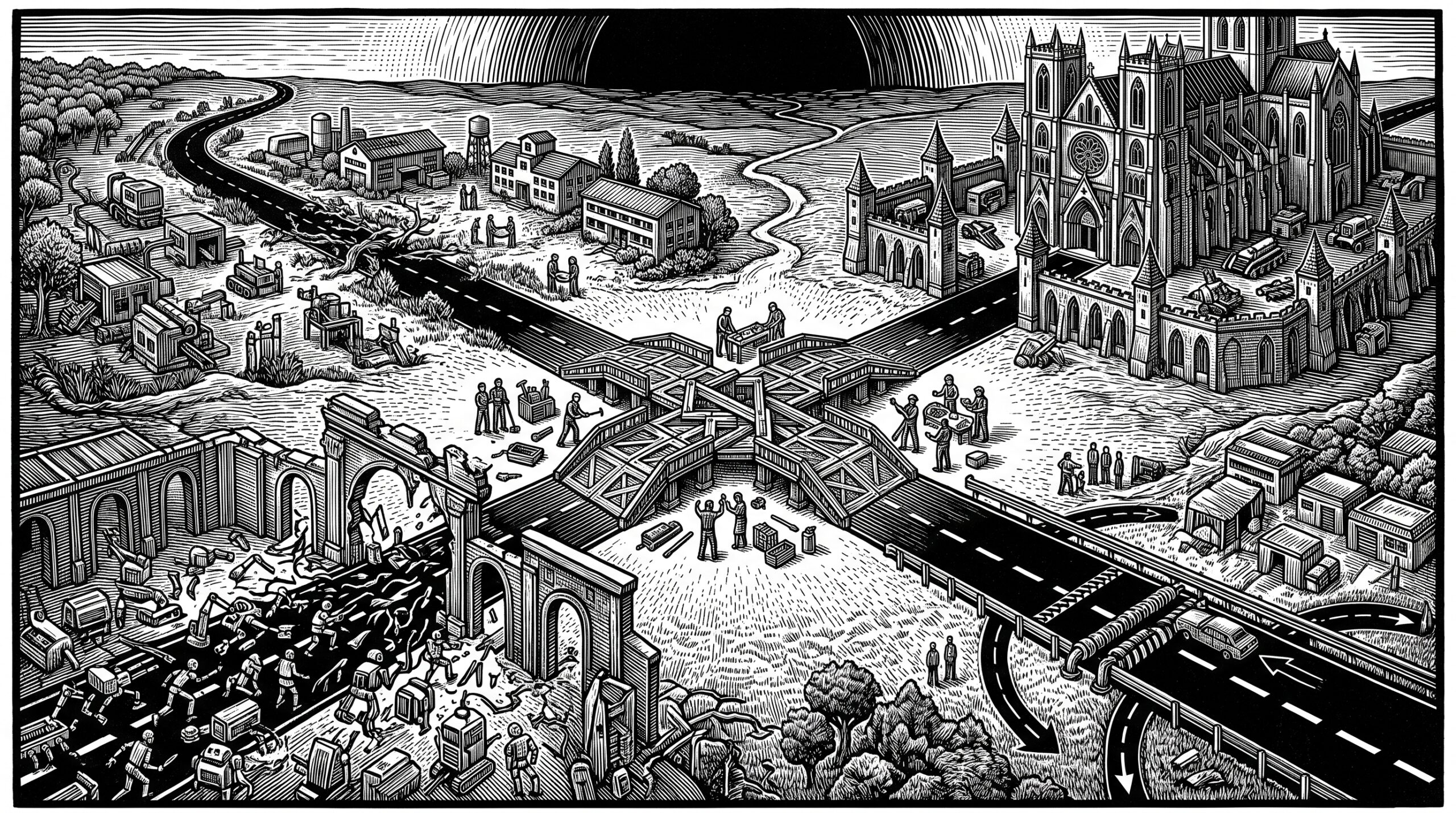
I am working on a book and have been rereading something I wrote in 2018 as part of the process. The old post is called “Pascal’s AI Wager.” Eight years have turned it into an exam I did not know I was taking.
There is no point grading an old prediction by quietly rewriting it in the light of what happened next. The 2018 post remains online with its claims, its confidence, and a few grammatical errors an AI assistant would probably have caught. This is useful. Memory is an accommodating editor. An archive is less polite.
The wager borrowed its machinery from Blaise Pascal. His famous argument asked us to place belief beside reality in a two-by-two matrix. God exists or does not. We believe or we do not. The infinities do the rest, although philosophers have spent centuries disputing whether they should. The argument survives because it turns uncertainty into a decision rather than because it settles theology.
My version asked whether conscious computers were possible and whether we believed they were possible. I populated its quadrants with Data from Star Trek, Skynet, Blade Runner, 1984, and a considerable portion of the science-fiction shelf. Then I advised caution and continued research.
Some of that aged well. Some did not. Let us open the envelope.
The Report Card Arrives
| 2018 claim | Grade | 2026 assessment |
|---|---|---|
| Neural networks will have consequences far beyond narrow software applications. | A− | Correct direction, insufficient specificity. |
| Belief changes behavior and preparation. | A− | Correct, but belief was treated too much like a switch. |
| AGI and conscious computers belong to nearly the same question. | B− | A common frame then, but capability has outrun the consciousness debate. |
| Near-term AGI is little more likely than it was fifty years earlier. | D | No definition or observable threshold made the forecast testable. |
| Proceed with utmost caution, but proceed nevertheless. | A | Still the right posture. |
| The four original quadrants describe the available futures. | C | Imaginative and dystopian, but missing the uneven middle. |
Overall grade: B.
This is an editorial grade, not a bit of fake precision masquerading as arithmetic. Two conclusions did most of the work. Neural networks mattered. Belief altered preparation. The largest error was putting consciousness at the center of a problem that capability could reach without it.
The A-minus for neural networks reflects direction without much resolution. I saw the wave before I could describe the shoreline. In 2018, saying neural networks might alter everything was bolder than it sounds now, but it was still too broad to guide a budget or a career. I also deserve the minus for copy that wandered past errors a machine would catch today without breaking stride.
Belief earns its A-minus because the last eight years have made it visible in capital expenditures, regulation, classroom rules, board agendas, and private experiments. Yet the old matrix treated belief as yes or no. Actual belief has layers. A person can expect enormous economic change while rejecting machine consciousness. A company can doubt AGI and still automate half a department. A government can dismiss extinction risk while restricting chips.
The B-minus is kinder to my consciousness argument because the question was legitimate and remains open. The error was architectural. I made consciousness support too much of the argument above it. Pull out that beam and the consequences remain standing.
The C belongs to the quadrants crowded with dystopia. Science fiction gave the post a language for fear, but little vocabulary for partial success. I imagined Skynet and Data more easily than a claims adjuster using a fluent statistical machine on Tuesday morning. The ordinary future arrived first.
Pinocchio Leaves the Building
The 2018 essay asked whether a computer could think or feel and become a sentient being like you or me. It drew heavily from Byron Reese’s The Fourth Age, sorting readers through monism or dualism before turning to their beliefs about the self. I remain comfortable with paradox. I am less comfortable using an unresolved ontological question as the gate through which every material consequence must pass.
By 2026, language models write software, analyze documents, tutor students, assist researchers, and conduct long chains of work through external tools. They also confabulate, flatter, lose context, and fail in ways that become more expensive as we grant them more authority. None of this proves they are conscious. None of it requires consciousness to matter.
A forklift need not understand the warehouse to change warehouse labor. An algorithm need not experience the self to alter hiring, credit, medicine, education, or war. The old post stared at Pinocchio and missed the factory growing around him.
That does not close the question. We still do not know what consciousness is, whether it emerges from sufficient complexity, or whether a machine could ever possess it. We also lack an agreed definition of artificial general intelligence. Some definitions turn on breadth of performance. Others require autonomy, learning, embodiment, or economic substitution. A few quietly smuggle consciousness back into the room.
This is why the D on my old probability claim stays. I wrote that the chance of AGI arriving soon was not much greater than it had been fifty years earlier. Perhaps that will prove correct under some future definition. I gave the reader no test. A forecast without a finish line cannot win, lose, or teach.
The correction for 2026 is straightforward. We can discuss capability, adoption, and consequence without pretending we have solved consciousness. The futures that require preparation are already visible in those three variables.
AGI may still become a useful name for a threshold. It may also become a historical label pasted across several thresholds after we have crossed them. The argument here does not need to decide. A society can be altered by systems below anyone’s definition of AGI, just as it can fail to prepare while waiting for philosophers and engineers to agree on the sign at the border.
Three Futures Meet Four
A recent Fortune article sent me back to the wager. It examines a new Anthropic Institute model of three economic futures.
In Anthropic’s baseline, AI behaves rather like the internet. Gains arrive gradually and remain inside historical experience. In its substantial-change scenario, AI can perform half of knowledge work by 2030, most of it autonomously, although firms do not adopt it for every eligible task. Economic growth doubles its ordinary rate. Knowledge-worker wages go flat while other workers gain.
Then comes the extreme scenario. AI outperforms humans at almost every knowledge task, performs nearly all such work autonomously, and creates almost no replacement knowledge work for people. Annual GDP growth reaches 15 percent. The economy doubles every four and a half years. Society becomes much richer while knowledge workers lose wages and jobs, along with their share of the larger pie.
The numbers are arresting. The omissions matter more.
Anthropic says its own explorer leaves out policy responses, business cycles, aggregate-demand shocks, financial-market disruption, and catastrophic risk. The demand problem glares. If millions of people lose income, who buys the flood of production responsible for the extraordinary GDP number? Perhaps ownership broadens, transfers rise, prices collapse, or entirely new demand appears. Perhaps not. A supply-side model can show what production permits. It cannot make purchasers materialize.
Fortune adds other friction. Enterprise adoption is moving at human speed. Companies must change processes, budgets, and permissions. Incentives must follow. Habits are slower still. Cyber incidents can break trust. Cheaper models that are good enough can displace expensive frontier systems without producing the recursive explosion imagined at the edge of the model.
There is another problem hiding inside the model. GDP measures production, not belonging. An economy can become richer while a class of workers becomes poorer, less secure, and less able to influence the institutions distributing the gain. Fifteen percent growth would be astonishing. It would not answer who owns the systems, who receives the income, or what work means when the market stops requesting much of what educated people trained to provide.
Anthropic presents these as scenarios and assigns them no probabilities. Even so, its extreme case makes the ownership problem visible. In the model’s distributional arithmetic, GDP stands 32.4 percent above the no-AI path by 2030, labor’s share falls from about 60 percent to 45.2 percent, and capital’s share rises to 54.8 percent. Total labor income barely changes. The economy has found abundance without giving workers a larger claim upon it.
Ethan Mollick’s Co-Intelligence approaches the future closer to the worker. His four possibilities include a plateau near current capabilities, slow continued growth, exponential progress, and AGI. He is interested in how it feels to work with the alien intelligence already here. The centaur divides tasks between person and machine. The cyborg blends the two throughout the work.
Anthropic counts output. Mollick watches practice. One model measures the economy from above while the other watches people improvise below. Together they expose what my 2018 matrix omitted. Capability and consequence do not move in lockstep. A model may improve overnight while an insurance company takes three years to approve it. A modest system may spread through a million jobs because its price falls to nearly nothing.
As I argued in The Expanding Blast Radius, consequences travel outward from builders through organizations and eventually into society. The radius can widen slowly or all at once. That realized pace belongs on the new wager’s horizontal axis.
Pascal Bets Again
The first wager crossed belief with existence. My 2018 wager crossed belief with the possibility of conscious computers. The 2026 version crosses preparation with the speed of the transition we actually experience.
| The transition remains gradual | The transition becomes explosive | |
|---|---|---|
| Prepare gradually | The Long Spring Adaptation keeps pace with disruption. |
The Unprepared Fitscape Institutions fail under a transition they treated as incremental. |
| Prepare for explosive change | The Cathedral of Precaution Preparation exceeds the threat and imposes its own costs. |
The Event Horizon Preparation meets radical change without pretending to predict what follows. |
This matrix substitutes preparation for belief because belief matters through action. A chief executive may publicly dismiss AI while buying GPUs. A government may announce confidence while drafting emergency authorities. An individual may call the technology hype and quietly use it every day. The wager lives in budgets, institutions, and habits.
Preparation also needs a time horizon. Buying a tool for next quarter differs from rebuilding a profession for the next decade. An individual can run experiments this afternoon. An organization may need a year to change its operating model. Society often discovers that a generation has passed before a school system has fully responded. The same wager therefore produces different clocks at each scale.
Its reality axis measures social and economic disruption rather than raw model capability. That distinction protects us from a common category error. A benchmark jump is not a labor market. A model release is not organizational adoption. A technical plateau can still produce years of diffusion, while an extraordinary capability may remain trapped behind cost, law, mistrust, or physical constraint.
In September 2026, Dario Amodei placed a wager of his own. In “We Must Pace the Frontier,” he argued that models helping to build later models had accelerated the frontier enough to justify buying roughly one or two additional years. That time would go to alignment and interpretability research. It would also fund better evaluations and operational care. His first move is concrete: give independent evaluators continuing, employee-like access inside frontier laboratories. The later moves require coordination among democratic companies and governments, then agreements with China. The proposal follows a July request from 1,386 frontier AI employees for government-backed tools that could deliberately slow automated AI development when needed.
His word pace names a different clock from mine. Amodei wants to slow capability development at the frontier. The horizontal axis in this wager measures how quickly technical change becomes lived economic and social disruption. Those clocks can separate. A laboratory may delay its next training run while companies continue spreading last month’s model through insurance and education, through hospitals and codebases.
That distinction places Amodei’s stages across more than one quadrant. Embedded evaluators are the kind of reversible preparation that can pay rent during a Long Spring and remain useful near an Event Horizon. A comprehensive international pause asks for verification strong enough to survive geopolitical defection; Amodei describes that level as unlikely soon. The wager has entered policy. One of the frontier’s builders has reached for the brake while warning that nobody can safely stop alone.
The Long Spring
Inside The Long Spring, preparation keeps rough pace with reality. Models improve. Costs fall. Firms absorb new practices over years rather than weeks. Workers change tasks while schools and professions respond, with labor markets given time to adjust. This is Anthropic’s baseline and part of Mollick’s slow-growth future.
It may also be the world we already mistake for stagnation. The internet did not arrive as one event. It accumulated through modems, browsers, corporate networks, smartphones, cloud services, and the slow death of things that once looked permanent. The transformation feels gradual while we inhabit it and abrupt when we look backward.
Society gets time to revise education and benefits. Organizations can test where AI works and where it merely performs competence. Individuals can learn the tools without wagering their identities on every product announcement. The danger is complacency. A long spring still changes the fitscape, and adaptation postponed remains adaptation owed.
The Cathedral of Precaution
In The Cathedral of Precaution, we prepare for an explosion that never comes, or comes much later than expected. Governments build agencies around speculative harms. Companies pour capital into compute they cannot use. Workers abandon durable crafts for an AI economy still waiting offstage. Fear becomes an industry with its own priesthood and appropriations.
This quadrant has real costs. Regulation can protect incumbents by making compliance affordable only to those already large. Overinvestment can strand infrastructure and divert capital from immediate needs. A worker can waste years preparing for a job category invented by a forecast.
Yet a cathedral is rarely empty. Better unemployment systems still pay claims. Portable health coverage still travels. Stronger cybersecurity still stops ordinary attackers. Education centered on judgment and verification remains useful even if model progress stalls. Preparation becomes a false alarm only when its value depends entirely on the explosion.
The sensible wager therefore prefers reversible moves with ordinary uses. This is where Pascal’s asymmetry needs repair. Over-preparation has a finite cost, but finite does not mean trivial, evenly shared, or politically recoverable.
The Unprepared Fitscape
In The Unprepared Fitscape, the transition becomes explosive while our plans assume continuity. AI substitutes for a large share of knowledge work faster than workers can move, companies can redesign themselves, or governments can replace lost income. Productivity rises on paper while demand and legitimacy fall. Social trust follows them through the floor.
This is the worst economic quadrant. It need not contain conscious computers, AGI, or a machine plotting against us. It requires only capability, cheap distribution, and authority arriving faster than adaptation.
At the societal level, institutions discover that twentieth-century benefits were attached to jobs that no longer carry the same share of income. At the organizational level, firms automate tasks without preserving the apprenticeship that produced senior judgment. At the individual level, yesterday’s expertise loses market value before its owner can build a second path.
The private answer cannot carry the whole burden. I called this the Lifeboat Fallacy: telling every person to reskill for a shrinking pool of work does not add seats. Preparation must occur at all three scales because the risk itself crosses them.
The Event Horizon
The Event Horizon survives from the 2018 wager. Rapid transformation arrives, but this time we have treated it as a possibility worthy of preparation. We have built shock absorbers, practiced with the tools, distributed some ownership, and learned where systems should not receive unilateral authority.
Preparation does not make the crossing safe. Anthropic’s extreme scenario requires assumptions that may fail, but any world approaching it would change faster than our models of wages and GDP can describe. New abundance might coexist with unemployment. Scientific acceleration might coexist with concentrated power. Systems capable of replacing knowledge work might also improve the systems that replace it.
Beyond the Event Horizon, prediction becomes low-budget entertainment. Preparation still matters because it preserves options. Society can keep people solvent and politically present. Organizations can preserve human judgment where errors compound. Individuals can learn enough to participate without surrendering every faculty to the machine.
The shadow sits inside the apparent success. A perfectly prepared transition may normalize surveillance, centralize control, and turn every human activity into an input for optimization. Survival is too low a grade for a future rich enough to offer abundance. The wager must preserve agency as well.
There is a deeper contradiction inside the Event Horizon. I ask preparation to preserve human agency while imagining systems that improve themselves and perform almost all knowledge work autonomously. Agency requires more than choosing among options a machine has prepared. It requires competence, bargaining power, and the ability to alter the course of events. If automated abundance removes those capacities, humanity may inherit extraordinary wealth as spectators only. We can think of this as The Agency Paradox: the same capability that creates the abundance may dissolve our power to shape the world it creates. Those wily fitscapes becoming fallacy themselves?
Three Scales, One Tuition Bill
A wager that ends with a matrix is a parlor game. The decision appears when we ask what preparation means.
For society, it means building institutions that can absorb a discontinuity without requiring one. For organizations, it means preserving options while measuring what the systems actually do. For individuals, it means becoming fluent enough to use AI while retaining the judgment to refuse it. Each sentence hides a program of its own.
Society’s work concerns distribution and continuity. If income moves from labor toward capital, then tax systems and benefits designed around wages will strain even while production rises. Schools face a different problem. They must prepare students for tools whose capabilities will change before a curriculum completes its review cycle. Democratic institutions must retain public consent while technical decisions migrate toward a small number of firms.
Organizations face the distance between a successful demonstration and a durable practice. They need to know which work can be delegated, which failures can be detected, and where human accountability must remain explicit. They also need an answer for apprenticeship. If AI performs the junior work, someone must still devise a path by which juniors become seniors.
Individuals receive the most immediate advice and the least control over the outcome. Learn the systems. Preserve the capacities they can weaken. Build relationships and financial room where possible. Yet no private collection of prudent choices can repair a society that distributes the shock badly. Personal preparation matters without becoming a moral alibi for institutional failure.
I will return to those programs in future posts. They deserve more than three tidy lists bolted onto the end of an argument. The immediate point is that all three scales interact. An individual cannot personally repair a labor market. A company cannot create public legitimacy by issuing an internal policy. A government cannot make a worker curious or a manager wise.
Preparation must match the level at which the consequence arrives.
This is also where the report card becomes useful. My 2018 self believed the decisive variable was whether we accepted the possibility of conscious machines. My 2026 self has a less romantic concern. What do we build while uncertainty remains?
The best preparations should pay rent in The Long Spring, retain value inside The Cathedral of Precaution, reduce suffering in The Unprepared Fitscape, and preserve agency as we approach The Event Horizon. They should not require a specific model release, an agreed definition of AGI, or faith in a 15 percent growth forecast.
The Debts Outside the Matrix
I should name what this wager leaves unpaid. Telling society to build institutions capable of absorbing a discontinuity identifies the destination without finding a road through political paralysis. Governments already struggle to repair unemployment insurance, modernize tax systems, and separate health coverage from employment. Asking those same institutions to prepare for an economic rupture they cannot yet see may be prudent. It is hardly a program.
The demand question cuts both ways. I fault Anthropic’s model for producing abundance without explaining who can afford to buy it, but my matrix supplies no mechanism for changing who owns the productive capital or receives its income. The capital-labor split is not weather arriving from offshore. Tax rules, ownership structures, bargaining power, public benefits, and political choices shape where the gains land. Preparation becomes a puppet show if it names the imbalance while treating its distribution as inevitable.
Reversibility has limits too. Portable benefits and stronger unemployment systems retain ordinary value if the explosion never comes. Universal income infrastructure, radical tax reform, or broad redistribution of AI ownership would change institutions, incentives, and constituencies before anyone knows whether the Event Horizon is real. Serious preparation may demand commitments we cannot quietly unwind. The Cathedral of Precaution therefore cannot be avoided merely by choosing useful building materials. Sometimes the wager requires us to pour concrete.
The Wager Survives
Pascal understood that belief does not remain in the head. It enters conduct. That insight survives the theology and both of my AI matrices.
We cannot choose whether artificial intelligence continues. The research is distributed, the capital committed, the incentives immense, and the useful results already among us. Abstention is no longer one of the quadrants. We can choose how much authority to grant, how broadly to distribute the gains, and how many futures our preparations can survive.
Belief should change preparation. Caution should change the manner of our advance. The future may resemble a long spring, a costly cathedral, an unprepared fitscape, or an event horizon that makes every grade provisional.
Proceed with utmost caution, but proceed nevertheless.
Leave a Reply